
Questions? Call Us 1–773–271–0318 9am to 2pm Central Time Mon.–Fri.

Instructional Scaffolding
for the Lesson Prior to the Introduction of the Standard Flat Periodic TableA Creative Periodic Table Teaching Strategy:
Converting a Tabular Element Arrangement into Three Dimensions...&vice versa
Instructional Scaffolding premise:
When students are first introduced to a new subject, certainly one as critical to Chemistry as the Periodic Table, they require a context, motivation, and foundation from which to understand this new information. As a preface to learning chemistry, now a constant learning tool for the student, and later a daily reference for the professional, the periodic table has no peer in science. Early in first chemistry courses, therefore, is the introduction of the Periodic Law and the Periodic Table – based on the work of Mendeleev and others.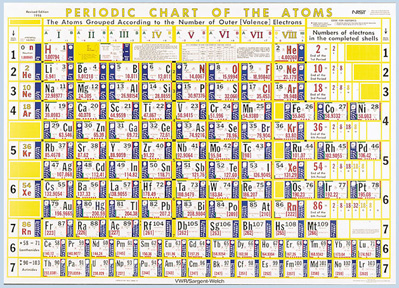
Drawing on prior knowledge, one of the primary strategies of instructional scaffolding, has good and bad features in regard to the periodic table. It is common knowledge that "Learning the Periodic Table" has become an icon of educational difficulty. The teacher is starting from behind with students who are already intimidated by the idea, an unnecessary obstacle to the already difficult job educating those who are free of any preconception.
Preceded by lessons introducing science and scientific method, chemical terms, measurements, matter, atoms, subatomic particles and elements, the periodic table is instrumental in learning about the properties of elements and how they relate and combine, in short, all of chemistry. The standard flat periodic table, is generally the tool employed for this effort.
Still propagated by the International Union of Pure and Applied Chemistry, the accepted authority, is both confusing and disjointed, and when one begins to associate it with the Periodic Law, the table is shown to be simply wrong in its many departures from the Law, providing an unstable basis for future learning, and introducing (reinforcing?) doubt in authority.
An immediately prior step is needed for students to be able to resolve previous visual and emotional context and to build a solid foundation for them to accept and understand the flat table lesson; in order to effectively and positively understand the importance of the huge, efficient, vital resource for practically all aspects of chemistry, that is the flat (of necessity) Period Table, and its many minor and major variations and applications.
Students modeling the periodic table – literally – by themselves, and creating an example of a periodic table with all of the tabular data and relationships intact, will interest, inform, familiarize, and generally ease every student into the next lesson – on how to appreciate and use the flat periodic tables. (Can fun and periodic table be in the same lesson? ...The same sentence?)
For fundamentally good, solid teaching to progress effectively in the introduction of the usefulness of a tabular chemical element arrangement, several techniques can be very valuable;1. Piqueing student interest and curiosity by offering a motivational activity, that of building a dimensional and colorful device which requires identification and physical manipulation of element groupings and their interrelationships.
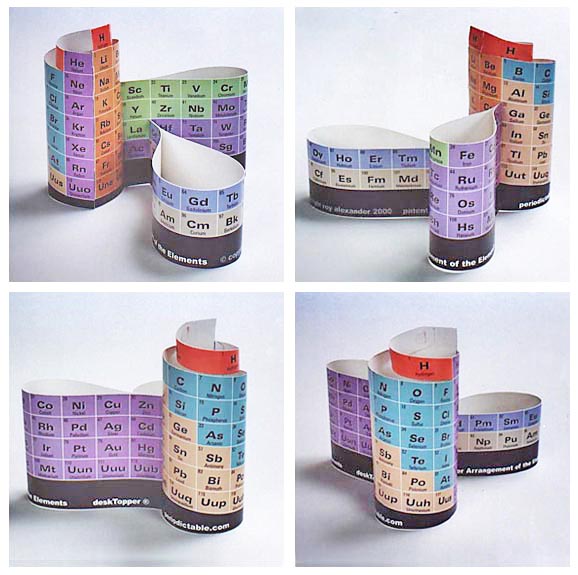
2. Facilitating student achievement by the procedures necessary in the construction of the model, providing a series of motivational successes framing the upcoming lesson material into a familiar context. The segments of the periodic table are presented to be detached and connected, then assembled in a chemical or historical sequence, finally forming a coherent 3D unit requiring manipulation for viewing all the elements.
3. Easing understanding of the icon of difficulty by breaking the task down into "doable" steps that can both incorporate prior knowledge (but not require it) and simply present complex concepts rationally and correctly.
4. Learning is tiered by this step–by–step approach, in that every part has its own story, and reasons made clear for why they must ultimately end up attached to certain others.
5. Facilitating student achievement by step–by–step procedures in the construction of the model provides a series of motivational successes while framing the upcoming lesson material into a familiar context.
6. "Tell me and I'll forget; show me and I may remember; involve me and I'll understand." Providing students with an opportunity for physical and intellectual participation in the examination and creation an example of the desired outcome, a teaching and learning opportunity not afforded by viewing a flat table.
7. Unique to the construction of the Alexander Arrangement is the capability of defining a historical timeline. This multi–disciplinary option may provide an additional context for learning for those with an interest in History. Either before or following connection of the element blocks, the first periodic table, of de Chancourtois' helix (1847) is formed by making a tube in which the p–block alone is visible – without, first, and then with the Noble gases exposed. Following that, the d block can be revealed, Mendeleev's table, and lastly, the f–block shown – in proper relationship to the others, the Alexander table. Personalities of contributing developers at each stage can be discussed – or studied.
8. As instruction continues in subsequent lessons, the AAE scaffold should be gradually withdrawn so that students will eventually be able to independently demonstrate comprehension of other representations of element relationships. The model can be folded for storage or brought home as a souvenir of one's first introduction to the Periodic Table – possibly for continued handy reference.– – – – – – –
Activating prior knowledge of the better–informed students is achieved by identification of elements of the flat table in the unassembled parts and retained in a better–related way by the completed model.
The rationality and novelty of assembling the Alexander Arrangement removes the fear of learning the dreaded periodic table on the one hand, and prevents it for other students.
The above outcomes can be achieved employing the Alexander Arrangement of Elements, which models the periodic table in a format that unassailably adheres to the Periodic Law and fully and accurately represents all the positive and correct features of the tabular Mendeleevian representation.
Teaching Ideas for Using the Alexander Arrangement of Elements in Class