|
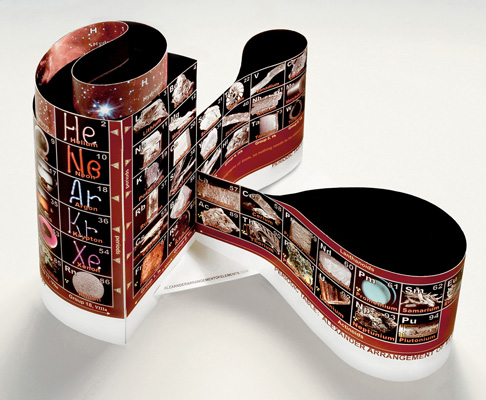
Questions and Answers about All Periodic Tables Q. What is the basis of a periodic table? A. Mendeleev, introducing his periodic table to the Russian Chemical Society in 1869, began by explaining, "The elements, if arranged according to their atomic weights, exhibit an evident periodicity of properties." Later "weights" were replaced by "masses", which have been replaced by "atomic numbers." In more general terms, the 2008 Wikipedia guide is "..certain properties of elements repeat periodically when arranged by atomic number." (details) Q. Did Mendeleev make the first periodic table? A. No. Alexandre Beguyer de Chancourtois' "telluric screw" was the first, as he proposed a classification of the then-known (1858) elements based on atomic weights, and plotted them on the surface of a cylinder, in a spiral. (details) Q. Why does Mendeleev get the credit? A. Thirteen years after the "telluric screw", and generally in parallel with Lothar Meyer’s work, Mendeleyev - not initially having had the benefit of seeing de Chancourtois’ 3D arrangement - proposed an improvement of an earlier flat table. It had eight columns, with gaps carefully arrived at related to the properties of adjacent elements. These gaps were later filled by others with previously undiscovered elements (scandium, gallium, and germanium) fitting his descriptions, and assuring his fame. (details) Q. Is his table the familiar one? A. No. There were shifts of his 8th column elements into another column, and a column (now called group) of gases added. The current, familiar flat form has been developed with adaptations by Bayley, then Werner, Moseley, and finally, Glenn Seaborg. (details) Q. What did Seaborg do? A. During his work on the atomic bomb during WWII, he and his group at Fermi Labs discovered numerous new elements. Insertion into the periodic table made the result too wide for convenience, so he proposed their removal from inside the table to a position below the remainder of the elements, under the lanthanides. (details) Q. What other locations for elements are in question? A. Hydrogen placement is problematic. Noted chemists and science philosophers are divided as to whether the H data should be placed in a box over Li, F, C, or no one group. The criteria vary, from atomic number triads, to electronic configurations, to ionization energy, both for H and He, and likely for others as well. (details) Placement of exit/re-entry points of the Rare earths are also in dispute, some leaving a blank on the flat chart below Sc & Y, others putting La & Ac there, and some promoting Lu & Lr for that spot. (details) Q. What is currently considered an "alternative periodic table" ? A. Any arrangement of element symbols and information, either 2 or 3 dimensional, not graphically represented in a flat grid such as that approved by the International Union of Pure and Applied Chemistry (IUPAC). (details) Q. Why do we need static charts and models when the Internet is full of interactive ones? A. One answer is its convenience and low cost due to mass production. Static charts require only the pages upon which they are printed rather than a computer and the Internet. A printed chart can not only be seen by students on the wall in virtually all science classrooms, they are in all chemistry books, and can be folded up and carried in a pocket. (details) Q. Why do we need 3D models when flat charts are so handy to use? A. Most 3D models are intended to show an unbroken numerical sequence of the elements for new students, allowing the learner to stay on track while tracing trends, similarities, or differences for any element, clarifying the relationships of the elements for high school through college level chemistry and affiliated fields, and often provide many improvements over the flat periodic table for serious chemists and students as well. As in the study of geography, where the globe introduces the concept, then maps are employed to permit closer examination of places on the globe -- however distorted they may become by comparison -- the 3D chart avoids the distortions necessary to portray element relationships on a flat surface, easing the learner into the daunting informational device that is the periodic table. They also provide more motivational, interesting, and usually hands-on, educational possibilities, while also appealing to a wider range of intellectual types. (details) |
|