
The Periodic Table in 3D
WHY and HOW the Alexander Arrangement Improves Learning and Eases Teaching
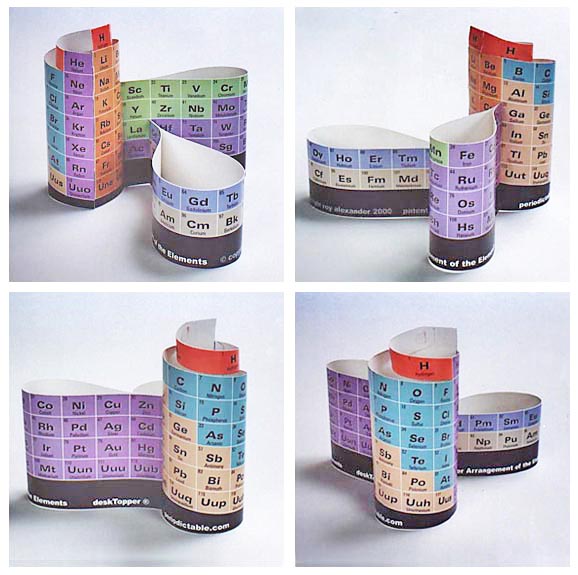
The DeskTopper Alexander Arrangement Model
$19.95 for 2
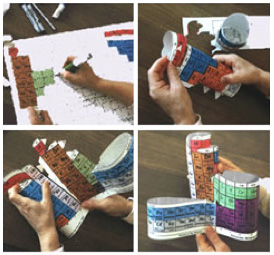
The Student Interactive Model
permits whole class participation.
special phone order only- 773-271-0318
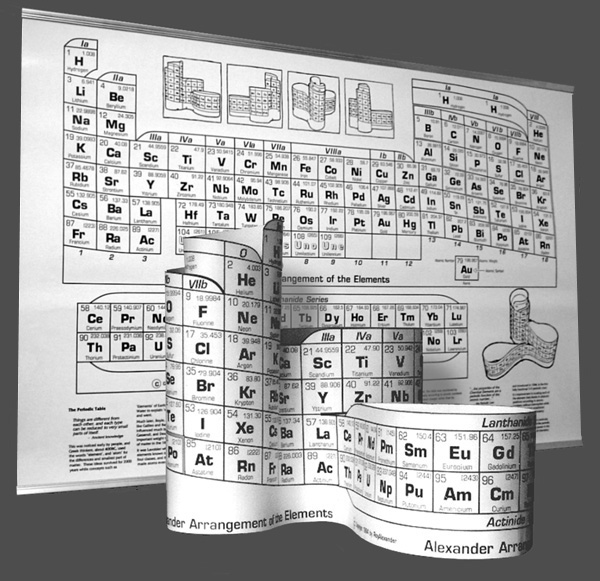
The AAE Display Model & Wall Chart arrived with both a wall chart and another diecut printing with the same graphics which converted to an Alexander Arrangement model the same size as the new
3D element photo Forever Periodic Table,
see below for 100% rebate of purchase price.
The Alexander Arrangement of Elements improvement for learning the periodic table was developed to eliminate the confusion and apparent inconsistencies in the flat table.
The design arranges the elements contiguously and continuously according to their atomic numbers by employing a patented helix in the p–block, joining the end of one period to the beginning of the next.
The theory of multiple intelligences has grabbed the attention of many educators around the country, and hundreds of schools are currently using its philosophy to apply to the various student learning styles.
Students generally fall into more than one of Gardner's multiple intelligences. Those other than word–, number–, and reasoning–smart may deliberately avoid or fail at the ordinary academics.
Teachers, most of them of the above intelligences, may have difficulty perceiving the needs of the others. It is important to address all the students, in Chemistry as in other school subjects.
All students have some of all the intelligences, most leaning more toward one or several. A 3D model of the periodic table touches on some of the intelligences often ignored, as well as addressing students capable of critical thinking. The periodic table is introduced at the beginning of chemistry, and so is of great importance.
The construction of the 3D model, an interactive and kinesthetic activity, has the student physically handle specific segments of the table, and deliberately place them in their correct locations relative to all the other parts, helping them to learn the names of the segments and see how obvious and logical the periods are.
The naturalist in students can identify the dimensionality of the periodic table with all other parts of nature – which are all also three dimensional. This association removes the table from the purely abstract to represent, as it informationally does, all of reality.
In a classroom session, the common experience of all to make their own periodic table (and to have it for themselves – perhaps to show to parents, siblings, etc. ...and have to then explain something about it) provides, initially, an interpersonal experience with classmates, and then a sense (and reality) of ownership. The flat tables will always be there for quick and easy reference, but the foundation for that table, will be solid – literally.
The pictured 3D models used in the introduction to chemistry, promote quick and easy familiarity with the periodic table for the new student.
Students characterized by the first of Gardner's three intelligences; " Linguistic ("word smart"), Logical–mathematical ("number/reasoning smart"), and Spatial intelligence ("picture smart"), can have the speed and clarity of their understanding of the flat table in universal use enhanced by enlisting other parts of their own intelligences.

AlexanderDESIGN 4851 N. Washtenaw Ave., Chicago, IL 60625 773.271.0318 last update 5/25/16